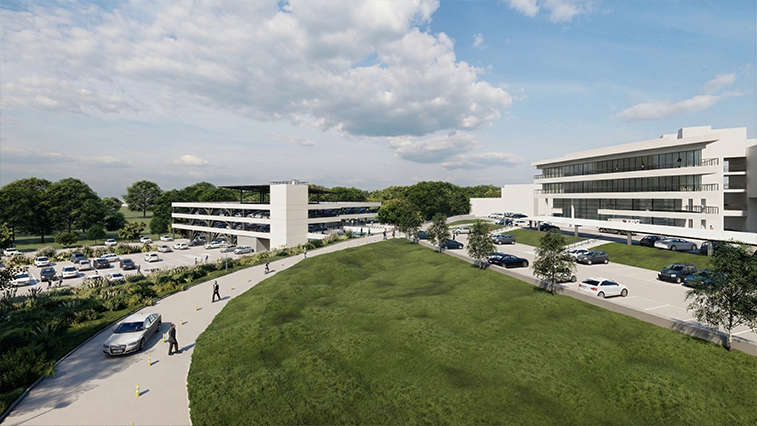
Overview: A Strategic Parking Solution for a Leading Cancer Treatment Center
This project outlines the design-build plan for a new multi-story parking silo at the Institut de Cancérologie de l’Ouest (ICO) in Saint-Herblain, France . The primary objective is to address current and future parking needs by significantly increasing capacity, optimizing vehicle and pedestrian traffic flow, and enhancing safety and comfort for patients, visitors, and staff . The project carefully analyzes the existing site to deliver a solution that is efficient, cost-effective, and preserves land for the institute’s future development .
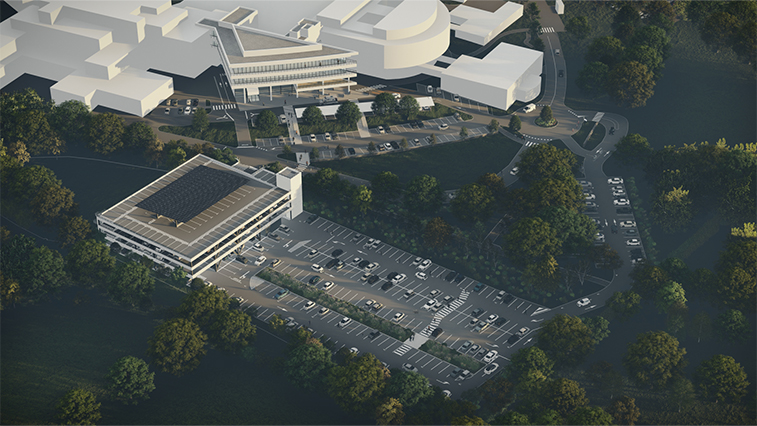
SITE ANALYSIS
Existing Conditions & Zoning
A thorough understanding of the site is critical to the project’s design . The existing parking is divided into three main zones to facilitate analysis :
- Zone A: Located nearest to the main ICO entrance, this area contains 81 parking spaces, including 7 for persons with reduced mobility (PMR), as well as drop-off points for quick access .
- Zone B: An area with 41 parking spaces that will remain unchanged by the new project .
- Zone C: A surface parking lot with 273 spaces, which is the designated site for the new parking silo, to be named Zone D .
Traffic Flow & Circulation Challenges
Optimizing the flow of light vehicles (VL), utility vehicles (VU), and pedestrians is essential .
- Access Route: Visitors primarily enter via the CHU’s west entrance and proceed to a roundabout that distributes traffic toward the ICO drop-off areas or the parking lots .
- Point of Vigilance: A significant challenge is the intersection of pedestrian and vehicle traffic between Zones C and A, near the ICO entrance, which requires careful management to ensure safety and fluidity . The presence of a bus line and vehicles coming from the south of the site further complicates circulation at the roundabout .
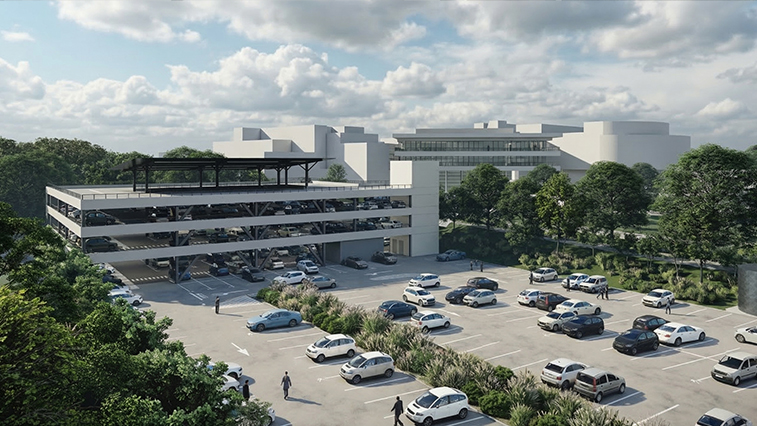
PROJECT PROGRAM & DESIGN DEVELOPMENT
Core Objective: Optimizing Capacity, Cost, and User Experience
The project team evaluated multiple architectural options to identify the one with the best ratio of parking spaces to cost, efficiency, and comfort . After a comprehensive study, Option 5 was selected as the most viable solution.
- Rejected Options:
- Option 1: Rejected for its excessive footprint, high costs, and lack of land reserve for future developments .
- Option 2: While efficient, it did not preserve usable land and created a high-risk traffic situation at a strategic junction .
- Option 3: A variation of the second option, it did not solve the land reserve issue .
- Option 4: Featured a difficult “chicane” circulation pattern and was poorly integrated into the site .
- Option 6: A variation of Option 5 with a curved ramp that offered no advantages, had a larger footprint, and featured more costly and less comfortable ramps .
- Selected Solution (Option 5): This option was chosen for its intelligent design and numerous advantages .
- Future-Proofing: It optimally integrates into the south of the site, preserving a maximum amount of land to the north for future ICO expansion .
- Cost-Effectiveness: The design optimizes costs relative to surface area and the number of columns to offer the maximum number of spaces within the budget .
- Optimized Flow: It ensures fluid circulation without diversions or accident-prone areas .
- Respect for Nature: The pedestrian and vehicle bridges are perfectly positioned to respect existing trees .
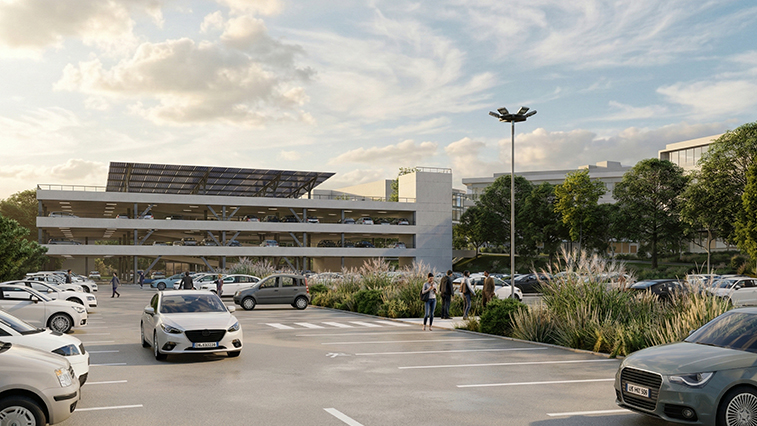
ARCHITECTURAL CONCEPT & DESIGN
A Vision of Seamless Integration and Functionality
The final design is strategically located at the southern end of the existing Zone C parking lot to minimize disruption during construction and maintain operational parking spaces . This positioning also allows for the potential construction of a future autonomous structure to the north, which could be connected by extending the silo’s pedestrian walkway .
- Structure & Circulation:
- The ramp is perpendicular to the existing parking circulation, creating linear aisles without sharp turns or blind spots . Its central position also helps minimize noise .
- For safety, pedestrian and vehicle bridges are kept separate . The main circulation core is located in the west corner to optimize pedestrian flow .
- Façade Treatment:
- The design creates a coherent architectural ensemble by echoing the horizontal elements of the existing ICO building . A “sur-façade” was deemed unnecessary .
- The materials include white painted concrete edge beams and a white main circulation core, with peripheral posts and guardrails painted grey to match the ICO building’s color scheme .
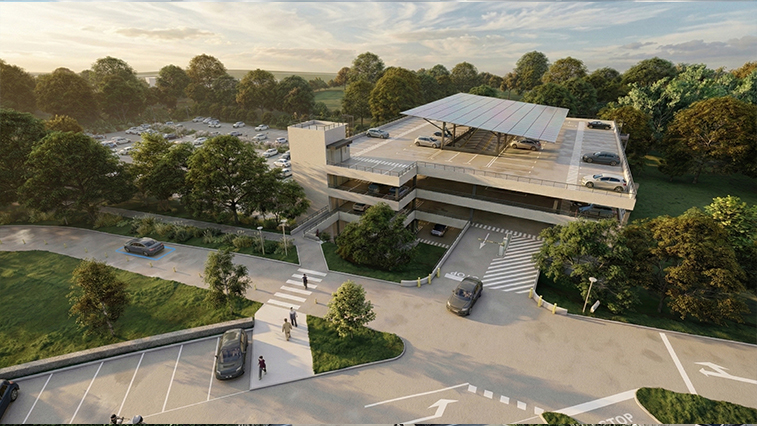
Scalable Capacity: Base, Variant, and Optional Configurations
The project is designed in scalable phases to meet evolving needs, starting from an existing total of 395 spaces .
- Base Project (R+2): This configuration increases the total parking capacity by 129 spaces, reaching a new total of 524 spaces .
- The new silo (Zone D) will provide 204 spaces (63 on the ground floor, 69 on R+1, and 72 on R+2) .
- In Zone A, 8 standard spaces will be converted into 6 PMR spaces to meet accessibility requirements .
- Variant Project (R+3): By adding a level to the silo, this phase increases capacity by 198 spaces, for a total of 593 spaces .
- The additional R+3 level adds 72 spaces .
- Optional Project (R+4): To achieve a target of 650-700 new spaces, this option expands the silo horizontally and vertically (to R+4) . This brings the final capacity to 935 spaces (+540) .
- The silo (Zone D) is expanded to provide 688-689 places .
- PMR capacity in Zone A is increased to a total of 17 spaces to satisfy regulatory requirements .
- This option still preserves over 3200m² of land for future development .